

Functional medicine for autoimmune disease in the context of family systems
There’s a better path to understanding and treating autoimmune disease
Autoimmune Families is the community and educational resource for families choosing a functional medicine path to healing, where you treat the why, not just the what, and we take a serious look at how.
Why look beyond the conventional approach?

When our teenaged son was diagnosed with a serious autoimmune disease in 2014, we were told he’d be on medication every day for the rest of his life. Potential side effects from the drugs were equally serious as the illness itself. We found that to be unacceptable and, we hoped, unnecessary, if we could just dig deeper and find a better approach. Enter functional medicine.

Why look beyond conventional medicine?
When our teenaged son was diagnosed with a serious autoimmune disease in 2014, we were told he’d be on medication every day for the rest of his life. Potential side effects from the drugs were equally serious as the illness itself.
We found that to be unacceptable and, we hoped, unnecessary, if we could just dig deeper and find a better approach. Enter functional medicine. Now, more than a decade later, he continues to thrive. And we all, as a family, learned some vital lessons that contribute to our wellness every day.

Treating the symptom isn't the same as treating the disease.
Conventional medicine was built for acute care, infections, and trauma. But autoimmune disease is complex and chronic. It requires deep inquiry into what's driving the immune system's misdirection, not just suppressing its effects with pharmaceuticals.
Functional medicine offers exactly that: a systems-based approach that asks why your immune system is attacking your own tissue, and then treats the underlying causes.
Focus Area |
Conventional Rx |
Functional Medicine |
|---|---|---|
| Primary goal | Treat symptoms | Heal the cause |
| Approach | Pharmaceuticals first | Root-cause investigation |
| View of the body | Isolated organ | Interconnected system |
| Patient role | Passive recipient | Active partner |
| Asks... | "What is happening?" | "Why is it happening?" |
“I had a hard time with the drugs prescribed for me when I was first diagnosed with a serious chronic autoimmune illness. I was running out of options. But then functional medicine changed my life. I am not dependent on pharmaceutical drugs, and my quality of life has improved dramatically. Where I was originally told that I’d need to be on medication every day for the rest of my life, I’m so glad to be able to say that that’s not what’s happening.”
- Tyler C. Age 18, diagnosed with ulcerative pancolitis at age 15
Understanding Functional Medicine
“Functional Medicine determines how and why illness occurs and restores health by addressing the root causes of disease for each individual.”
A smarter framework for chronic illness

Root Cause Analysis
FxM practitioners test for underlying triggers, toxins, infections, nutrient deficiencies, gut imbalances, and chronic stressors that drive immune dysregulation.

Highly Individualized Care
Your genetic makeup, environment, and history are unique. Functional medicine crafts a treatment plan specific to your biology, not a one-size-fits-all protocol.

Therapeutic Partnership
The practitioner-patient relationship in FxM is collaborative and investigative. You're an active participant in your own healing, not a passive recipient of a prescription.

Prevention & Long-Term Health
Beyond treating what's active, functional medicine aims to prevent future flares and reduce pharmaceutical dependence by building a resilient, balanced system.
The Functional Medicine Lens
What's actually driving your autoimmune disease?
Autoimmunity rarely has a single cause. FxM practitioners look at the full picture, identifying and treating the complex web of triggers that conventional medicine often overlooks.

-
Persistent viral, bacterial, or parasitic infections can chronically stimulate immune response and contribute to autoimmune misdirection.
-
Heavy metals, mold, pesticides, and other environmental exposures can trigger and perpetuate immune system dysfunction.
-
"Leaky gut" allows undigested food particles and bacteria into the bloodstream, provoking widespread inflammatory immune responses.
-
Unresolved psychological and physiological stress disrupts cortisol rhythms and immune regulation, fueling autoimmune flares.
-
Genetics load the gun; environment pulls the trigger. FxM explores epigenetic factors that activate or suppress your genetic risk.
-
Deficiencies in key micronutrients can impair immune regulation and healing capacity.
Your Path Forward
A new approach to living with autoimmunity
You don't have to accept a lifetime of escalating medications as the only answer. Functional medicine offers a structured path. It’s one that requires your active engagement, but returns something powerful: a real understanding of your own body.
01 Identify triggers
Work with a qualified FxM practitioner to run a comprehensive investigation, tests that conventional medicine typically doesn't order.
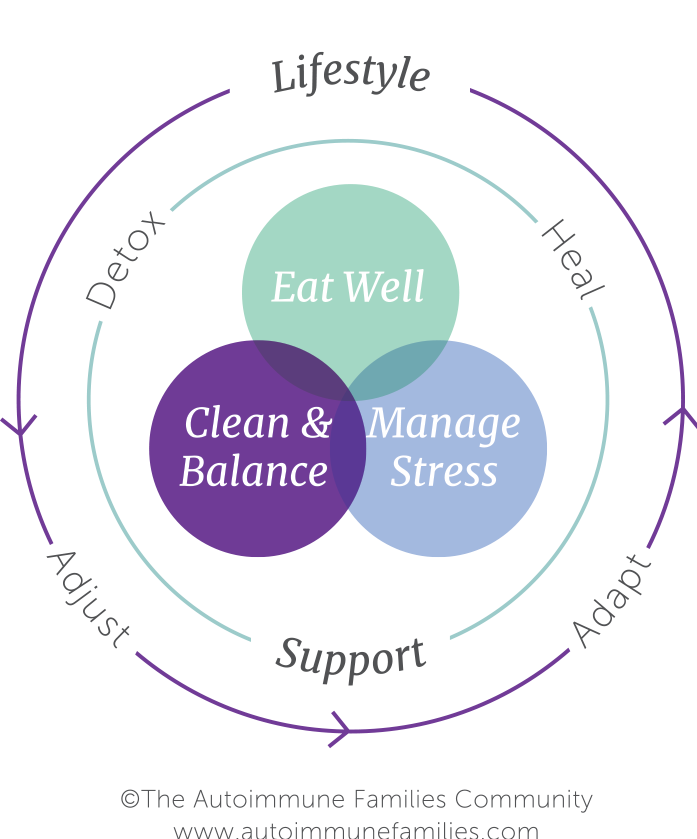
02 Remove & repair
Systematically address the identified drivers: detoxify, heal the gut, and adjust the diet, tailored to your biology.
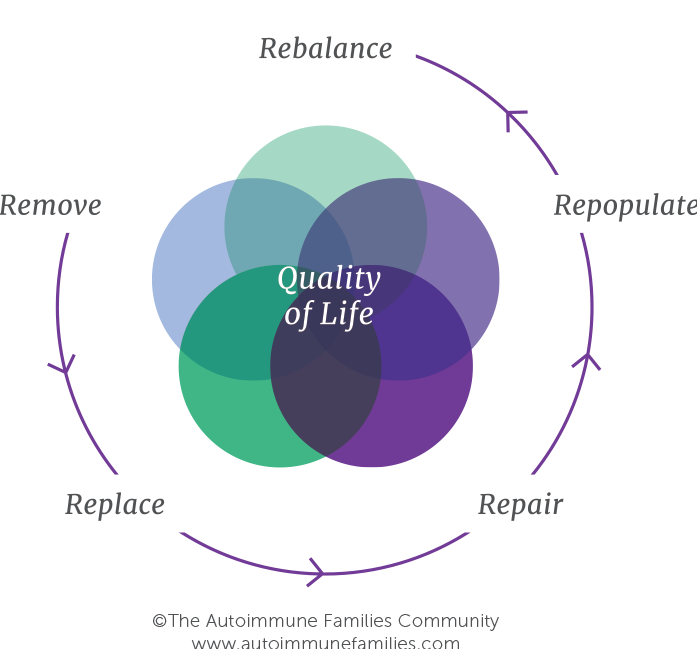
03 Repopulate and rebalance
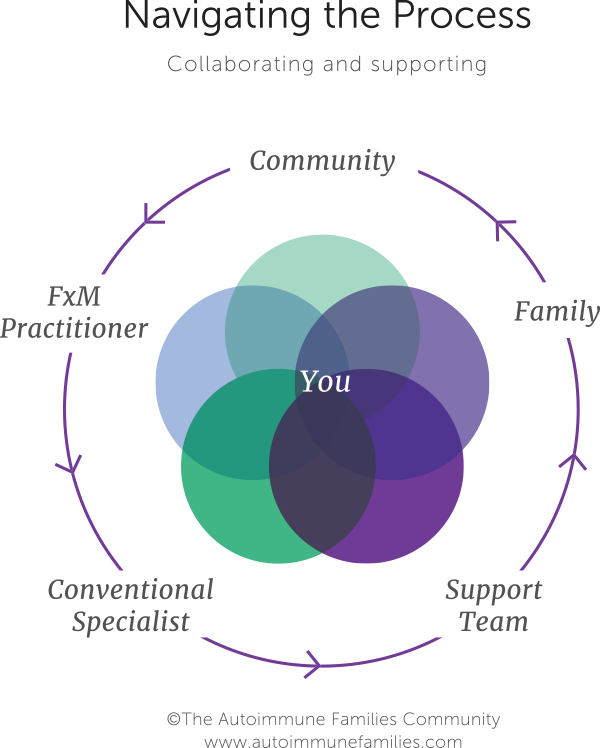
Restore your microbiome (such a key driver!). Learn how to rebalance and manage stress. Learn how to integrate your conventional specialist with your FxM practitioner for optimal results.

Learn how to improve quality of life

How can The Autoimmune Families Community help?
Get your "you" back
Pursuing a collaborative approach with functional medicine can help put you in the driver’s seat in navigating chronic illness, not just relegate you to the status of passenger. Like all solutions, it only works if you do it. So, ask yourself: am I ready to feel better?
Focus on family systems
Living with chronic illness impacts more than just an individual; it affects the family as a whole. Roles and identities shift, and processes like grieving and adapting to change deserve attention. Learn what you can do to give and get the support you need.

Autoimmune Families Community
Autoimmunity is a family disease. You need more than a prescription
Whether you're a patient, a caregiver, or a parent navigating a child's diagnosis, we understand that chronic illness reshapes the entire family system. Our community gives you tools, decision support, and access to professional resources who can help you move toward sustainable wellness.
Focus on family systems
Living with chronic illness impacts more than just an individual; it affects the family as a whole. Roles and identities shift, and processes like grieving and adapting to change deserve attention. Learn what you can do to give and get the support you need.
Frequently Asked Questions
Your questions about functional medicine, answered.
If you're new to functional medicine, these are the questions most people ask first. Here’s a quick introduction, linked to deeper resources for additional insight.
-
Functional medicine is an evolution in medical practice that treats the whole person, not just a set of isolated symptoms. Rather than asking, "What disease do you have?" a functional medicine practitioner asks, "Why is your body behaving this way?" Certified functional medicine practitioners use a systems-based approach to identify the root causes of chronic illness, considering triggers as well as genetic, environmental, and lifestyle factors that drive disease.
Unlike conventional acute-care medicine, which was developed to address infectious disease and trauma, functional medicine is built for the complexity of chronic illnesses like autoimmune disease.
→ Read our full overview: What is Functional Medicine?
-
Some functional medicine practitioners are MDs (medical doctors), while others may hold degrees as DOs, NPs (nurse practitioners), or other licensed healthcare professionals. What unifies them is additional training and certification in functional medicine, most commonly through the Institute for Functional Medicine (IFM), which offers a rigorous certification program (IFMCP).
The important thing is not just the degree, but whether the practitioner has substantive training in the functional medicine model, and whether they're the right fit for your specific health situation.
-
Yes, if your functional medicine practitioner is a licensed MD, DO, or nurse practitioner, they can prescribe medication. Functional medicine does not reject pharmaceuticals; it simply aims to minimize reliance on them by addressing root causes first. In cases of active disease or moderate-to-severe flares, pharmaceutical intervention may absolutely be part of the plan.
The goal of functional medicine is to work alongside, not against, necessary medications, while simultaneously addressing the underlying triggers so that, over time, your reliance on pharmaceuticals may be reduced.
-
This varies widely by provider, practice, and insurance plan. Some functional medicine practitioners operate outside of insurance networks (out-of-pocket or direct primary care models), while others do accept insurance for certain services. Many of the specialized laboratory tests ordered in a functional medicine approach may or may not be covered, depending upon your plan.
It's worth calling your insurance provider and the practitioner's office directly to ask what is and isn't covered before beginning care. Some patients find that HSA/FSA accounts can help offset costs for out-of-pocket FxM services.
-
Functional medicine care costs vary significantly based on the practitioner, location, and scope of testing. Initial consultations, which are often longer and more comprehensive than conventional appointments, can range from a few hundred dollars to over a thousand. Specialized lab testing (gut microbiome panels, heavy metals testing, and advanced hormone panels) may add additional costs.
Many families find that investing in functional medicine over time reduces long-term costs associated with ongoing pharmaceutical management, hospitalizations, and lost productivity. There is a significant human cost to not looking at root causes, even if the immediate out-of-pocket is not financial.
That said, up-front monetary cost is a real consideration. Our decision-support tools can help you navigate options and prioritize where to start.
Ready to find the root cause?
Join families who have chosen a functional medicine path. Your healing journey begins with asking better questions.

We're stronger together
We'll share our experience, help you deepen your knowledge and understanding of the factors that affect autoimmunity, and provide decision support and frameworks that can help reduce the overwhelm and speed the path toward recovery.

Find the right path for you
You have to navigate through making the decisions that will best support you. This can be challenging when experts contradict each other, and you have to decide whose voice to listen to, and where to put your trust. We can help you process it.

Learn and build with us
Understand which topics resonate with you and your health situation, so you can form a better line of inquiry with your provider(s). Your specific needs can also help shape our conversation to better meet your needs and experience.